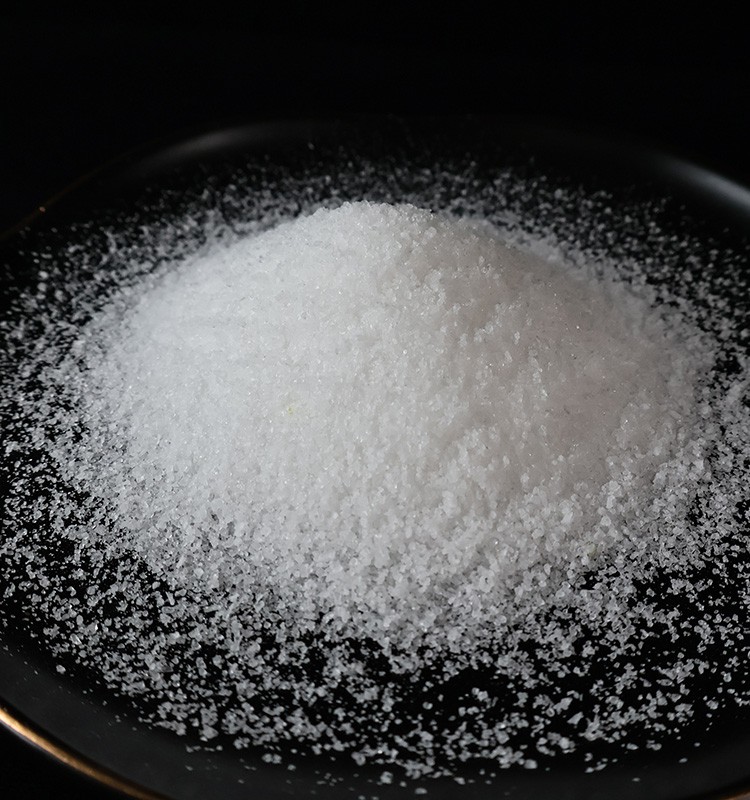


Polyacrylic Amide is a polymer compound synthesized from acrylamide monomers.Due to its unique molecular structure and excellent properties, it is widely used in dozens of fields,including water treatment,oil extraction,papermaking, textiles, agriculture, and medicine.
The molecular chain of Polyacrylic Amide consists of repeating acrylamide units(-CH₂-CHCONH₂-).Its properties can be controlled by parameters such as degree of polymerization,molecular weight,charge type, and distribution,resulting in a diverse range of product systems.
1.Wide molecular weight range to meet different needs
The molecular weight of Polyacrylic Amide can range from tens of thousands to over 20 million.The higher the molecular weight,the longer the molecular chain,the greater the viscosity of the resulting solution,and the stronger the adsorption and bridging ability.For example:
Low molecular weight PAM(<1 million):Dissolves quickly,suitable for rapid flocculation scenarios(such as domestic sewage treatment);
Medium-high molecular weight PAM(1 million-10 million):Good flocculation effect,commonly used in industrial wastewater treatment;
Ultra-high molecular weight PAM(>10 million):Strong thickening properties,used for thickening oil drilling fluids or coatings.
2.Diverse charge types,highly targeted functions
Based on the charge distribution on the molecular chain,Polyacrylic Amide can be divided into nonionic(NPAM),anionic(APAM),cationic(CPAM),and amphoteric(AmPAM).
1.Nonionic PAM has no charge on its molecular chain,used in acidic wastewater treatment,paper dispersants,has strong salt resistance,and a wide pH range(2-10).2.Anionic Polyacrylic Amide has a negatively charged molecular chain(-COO⁻),making it effective in treating dyeing and printing wastewater and electroplating wastewater,and exhibiting good flocculation effects on high-valence metal ions(such as Fe³⁺).
3.Cationic Polyacrylic Amide has a positively charged molecular chain(-CONH₃⁺),suitable for use in municipal sewage,sludge dewatering,and papermaking retention and filtration aids,with strong adsorption capacity for negatively charged suspended solids(such as bacteria and colloids).
4.Amphoteric Polyacrylic Amide contains both positive and negative charges,suitable for treating high-salt wastewater and complex water quality,exhibiting strong salt and shear resistance,and adapting to extreme environments.
3.Adjustable degree of hydrolysis,flexible performance
Anionic Polyacrylic Amide can adjust its degree of hydrolysis(i.e.,the proportion of-COO⁻)through a hydrolysis reaction(reaction with sodium hydroxide),thereby changing its solubility,flocculation rate,and precipitate density.For example:
Low degree of hydrolysis(10%-20%):suitable for treating low-temperature,low-turbidity water;
High degree of hydrolysis(30%-50%):significantly effective for wastewater with high turbidity and high organic matter content.
II.Physical Properties:Forms and Solubility Adapt to Diverse Scenarios
The physical form(solid,emulsion,colloid)and solubility characteristics of Polyacrylic Amide directly affect its storage,transportation,and usage efficiency.
1.Diverse Forms to Meet Different Process Requirements
Solid Powder:High purity(>90%),low transportation cost,but requires on-site dissolution and is prone to clumping;
Emulsion:Uses water or oil as the dispersion medium,dissolves quickly(5-15 minutes),but has poor storage stability(requires the addition of stabilizers);
Colloid:Between powder and emulsion,has better solubility than powder,but higher viscosity,requiring specialized equipment for transportation.
Typical Case:A paper mill used emulsion-type cationic PAM to replace solid powder,reducing flocculation time from 30 minutes to 10 minutes,and eliminating the need for a dissolving tank,saving 20%on equipment investment.
2.Excellent Solubility and Simple Operation
Polyacrylic Amide is readily soluble in water,but the dissolution rate is affected by molecular weight,form,and stirring conditions.To avoid"fish eyes"(undissolved particles),the following principles should be followed:
Dissolution concentration:Generally controlled at 0.1%-0.5%,excessively high concentrations can easily lead to molecular chain entanglement;
Stirring speed:50-100 rpm,to avoid shear forces damaging the molecular structure;
Dissolution time:Powder requires 60-90 minutes,emulsion only requires 5-15 minutes.
3.Good thermal and chemical stability
Temperature tolerance:Short-term use temperature can reach 80℃,long-term use is recommended≤60℃,high temperatures can easily cause molecular chain breakage;
pH adaptation:Non-ionic PAM is stable within the pH range of 2-10,anionic/cationic types need to be adjusted according to the specific type;
Shear resistance:The higher the molecular weight,the weaker the shear resistance,high-speed pumping or vigorous stirring should be avoided.
III.Functional Advantages:Core Performance Drives Wide Applications
The core functions of Polyacrylic Amide include flocculation and sedimentation,thickening and viscosity enhancement,drag reduction and viscosity reduction,and adsorption bridging,which are key to its status as an"industrial MSG."
1.High-Efficiency Flocculation and Sedimentation for Water Purification
Polyacrylic Amide,through charge neutralization,adsorption bridging,and net-like sweeping effects,enables the rapid aggregation and sedimentation of suspended solids.It is widely used in:
Municipal Wastewater Treatment:As a flocculant,it can be combined with aluminum and iron salts to improve sludge dewatering efficiency(the moisture content after dewatering can be reduced to below 60%);
Industrial Wastewater Treatment:It shows significant treatment effects on dyeing and printing wastewater(removing COD and color),electroplating wastewater(recovering heavy metals),and papermaking wastewater(recovering fibers);
Drinking Water Purification:Low-residue,non-toxic non-ionic PAM can be used for source water pretreatment to reduce turbidity.
Data Support:After using cationic PAM,a dyeing and printing factory reduced its wastewater COD from 1200 mg/L to 200 mg/L and its color from 800 times to 50 times,meeting national emission standards.
2.Strong Thickening and Viscosity Enhancement,Optimizing Process Flow
The Polyacrylic Amide molecular chains form a three-dimensional network structure,significantly increasing solution viscosity.Applications include:
Oil Extraction:As a drilling fluid thickener,it carries drill cuttings,cools the drill bit,and prevents wellbore collapse;
Paints and Inks:Adjusting leveling properties and preventing pigment sedimentation;
Building Materials:As a cement mortar water-retaining agent,it reduces cracking and increases strength.
Case Study:After using ultra-high molecular weight PAM(18 million molecular weight),an oilfield increased its drilling fluid viscosity from 30s to 60s(Marsh funnel viscosity),improving drilling efficiency by 15%.3.Reduced Drag and Viscosity,Improved Transportation Efficiency
In pipeline transportation,Polyacrylic Amide can reduce fluid turbulence and energy loss.Applications include:
Crude Oil Transportation:Adding 10-50 ppm PAM can reduce frictional resistance by 30%-50%;
Wastewater Treatment Plants:Reduces energy consumption of sludge transfer pumps and extends equipment life.
4.Adsorption and Bridging,Enhanced Solid-Liquid Separation
In sludge dewatering,mineral processing,and sugar refining,PAM adsorbs tiny particles to form large flocs,improving separation efficiency:
Sludge Dewatering:When used with belt filter presses and centrifuges,the moisture content of the sludge cake can be reduced to below 60%;
Mineral Processing:As a flotation depressant,it improves concentrate grade;
Sugar Refining:Clarifies sugar juice and reduces settling time.
IV.Environmental Protection and Economic Efficiency:A Choice for Sustainable Development
The environmental advantages of Polyacrylic Amide are reflected in its low residue, biodegradability,and potential for resource utilization:
Biodegradability: Some PAM(such as non-ionic PAM)can be decomposed into CO₂and H₂O by microorganisms;
Resource Recovery: In wastewater treatment,PAM can be co-incinerated with sludge to generate electricity, achieving energy recovery;
Cost-Effectiveness:Taking sludge dewatering as an example, after using PAM, the sludge volume is reduced by 50%-70%, and transportation and disposal costs are significantly reduced.
Polyacrylic Amide,with its designable molecular structure,adaptable physical properties, and diverse functions, has become an indispensable polymer material in modern industry. From water purification to oil extraction, from papermaking and textiles to agricultural improvement, its applications are constantly expanding, and technological iteration is accelerating. In the future, with increasing environmental protection requirements and advancements in processing technology, polyacrylamide will develop towards greener, more functional, and more composite directions, providing stronger support for sustainable development.

 E-mail:jcl@jichanglong.com
 WhatsApp:+8618560709619
 Address:Block B, Polymer Materials Industry Innovation Park,No. 51, Lutai Avenue, High-tech Zone, Zibo City, Shandong Province
China vanadium inhibitors manufacturer Shandong Jichanglong Environmental Engineering Co., Ltd.
Jichanglong specializes in vanadium inhibitor , dehumidification and drying block, calcium hypochlorite disinfectant tablets, polyacrylamide and other products. With over 20 years of experience, we offer quality assurance and wholesale prices.



