Against the backdrop of continuously upgraded public health management and growing demands for water environment governance, selecting an efficient, safe, stable, and user-friendly disinfectant is crucial for ensuring environmental hygiene and safeguarding public health. Trichloroisocyanuric acid (TCCA) disinfection tablets have emerged as one of the most widely used solid chlorine-based disinfectants globally. This is due to their exceptionally high available chlorine content, potent bactericidal efficacy, sustained slow-release effect, and broad applicability. The World Health Organization (WHO) has designated TCCA tablets as a recommended product for drinking water disinfection.
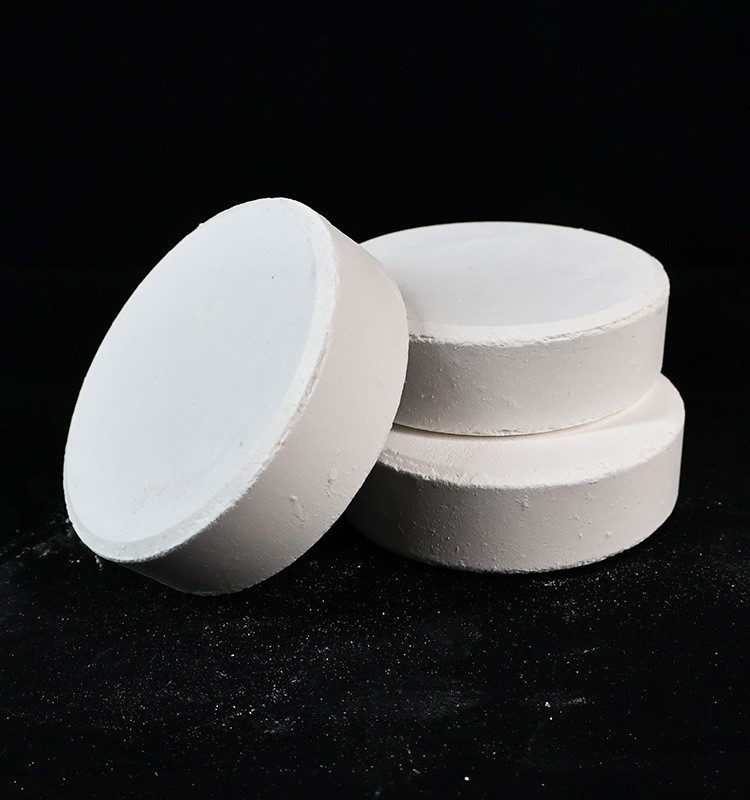
Trichloroisocyanuric acid (chemical formula C₃Cl₃N₃O₃) is an organic chlorine compound with high chlorine content. It typically exists as white or light yellow tablets, granules, or powder, exhibiting strong oxidizing and bactericidal properties. As a member of the isocyanurate compound family, it is a solid disinfectant derived from chlorinated isocyanurate, boasting an effective chlorine content exceeding 90%—significantly higher than traditional bleaching powder or sodium hypochlorite. Due to its high efficiency, ease of storage, and user-friendly application, trichloroisocyanuric acid tablets are hailed as the “next-generation high-efficiency chlorine-based disinfectant.”
When dissolved in water, trichloroisocyanuric acid gradually decomposes and releases hypochlorous acid (HOCl) according to the following chemical reaction:
C₃Cl₃N₃O₃ + 3H₂O → C₃H₃N₃O₃ + 3HOCl
The resulting hypochlorous acid is a potent oxidizing agent capable of disrupting bacterial cell walls, viral protein coats, and fungal spore structures, thereby achieving highly effective sterilization.
Compared to traditional chlorine-based disinfectants, TCCA tablets offer the following significant advantages:
(1) High chlorine content and broad-spectrum disinfection: TCCA boasts an effective chlorine content of up to 90%, delivering rapid disinfection with stable concentration. It exhibits potent inactivation against bacteria, viruses, fungi, algae, and other microorganisms, achieving disinfection rates as high as 99.9%.
(2) Strong sustained-release action: After dissolving in water, TCCA gradually releases hypochlorous acid through a sustained-release mechanism. This provides long-lasting disinfection, making it ideal for applications requiring prolonged residual chlorine maintenance, such as swimming pools, landscape water features, and industrial circulating water systems.
(3) Safe, convenient, and easy to use: Tablet-based dosing requires no complex preparation, eliminating risks associated with liquid chlorine or bleach solutions prone to leakage and decomposition. This ensures greater safety and reliability in water treatment.
(4) Excellent stability and convenient storage/transportation: Its solid form provides heat and moisture resistance, preventing decomposition and facilitating long-term storage and transportation. TCCA holds a vital position in global emergency relief supplies.
(5) Cost-effective with high efficacy: TCCA offers low unit cost per effective chlorine dose, achieving significant disinfection results with minimal dosage, making it an exceptionally cost-effective sanitizer.
TCCA tablets are suitable for purifying urban water supplies, rural drinking water, and emergency post-disaster water sources.
Upon dissolution, the hypochlorous acid released rapidly eliminates pathogens such as Escherichia coli and Staphylococcus aureus, ensuring drinking water safety. Its high efficacy and stability make it one of the disinfectants recommended by the World Health Organization (WHO) for drinking water treatment.
Particularly in remote areas, field operations, or natural disaster relief, trichloroisocyanuric acid tablets serve as emergency water purification agents. Simply dissolve an appropriate amount in water, stir thoroughly, and allow to stand for 30 minutes before safe consumption.
TCCA tablets are currently one of the most widely used water disinfectants in swimming pools. They effectively prevent bacterial, viral, and algal proliferation, maintaining clear and transparent water. Compared to liquid chlorine or sodium hypochlorite, TCCA tablets offer advantages such as stable release, no irritating odor, and safer handling. Their slow-release properties maintain constant residual chlorine levels in pools, ensuring long-term disinfection and water quality stability.
Trichloroisocyanuric acid tablets are also commonly used in hot springs, fountains, artificial lakes, and landscape water systems to control microbial growth and algae proliferation.
In public spaces such as hospitals, schools, subways, shopping malls, hotels, and restaurants, TCCA disinfection tablets are widely used for disinfecting floors, walls, restrooms, door handles, and air environments. Diluted solutions can be applied via wiping, spraying, or mopping to effectively prevent cross-contamination and infectious disease transmission.
Additionally, trichloroisocyanuric acid tablets demonstrate superior efficacy in cleaning and disinfecting medical equipment, surgical instruments, garments, linens, and medical waste bins.
In industrial cooling towers and circulating water systems, bacteria and algae readily proliferate, causing pipe corrosion and blockages. TCCA tablets, as an oxidizing biocide, inhibit microbial growth, decompose organic matter, and eliminate odors. In industrial wastewater and municipal sewage treatment, trichloroisocyanuric acid tablets effectively eliminate harmful microorganisms, reduce biochemical oxygen demand (BOD), improve water quality, and prevent pollution spread.
TCCA tablets have extensive applications in agriculture and animal husbandry:
- Aquaculture: Disinfects breeding ponds, kills bacteria, viruses, and parasites in water bodies, and prevents fish and shrimp diseases.
- Livestock Farms: Used for cleaning and disinfecting pens, drinking equipment, and rearing environments to reduce animal diseases.
- Agricultural irrigation: Purifies irrigation water to prevent transmission of plant pathogens.
Its low toxicity and minimal residue characteristics enhance safety and cost-effectiveness in aquaculture.
TCCA disinfection tablets are suitable not only for industrial applications but also for daily household cleaning:
- Disinfecting kitchens, bathrooms, floors, and pet supplies;
- Sterilizing and cleaning tableware, clothing, towels, and other daily items;
- Emergency drinking water treatment for camping, travel, earthquakes, floods, etc.
Simply dissolve the appropriate number of tablets in water to quickly produce safe and effective disinfectant solution.
Different application scenarios require solutions of varying concentrations. Below are common reference dosages:
- Drinking water disinfection: 0.3–0.5g TCCA per ton of water;
- Swimming pool water: 2–4g per cubic meter of water;
- Medical equipment immersion: 0.5%–1% solution, soak for over 30 minutes;
- Aquaculture ponds: Add 2–3g per cubic meter of water;
- Floor cleaning: Wipe with 0.2%–0.5% solution for disinfection.
(Note: Follow manufacturer instructions or relevant industry standards during actual use to avoid overuse.)
Although trichloroisocyanuric acid tablets are a safe and effective solid chlorine source, observe the following precautions during use:
(1) Avoid mixing with acidic substances or organic materials to prevent release of toxic chlorine gas;
(2) Store in a cool, dry place away from sunlight, heat sources, and flammable materials;
(3) Wear protective gloves and masks to prevent skin contact or dust inhalation;
(4) Control dosage appropriately; overuse may cause corrosion or residual chlorine odor;
(5) Prepare solutions immediately before use to prevent effective chlorine degradation.
Amid heightened global public health and environmental standards, trichloroisocyanuric acid tablets are evolving toward enhanced stability, reduced residues, and eco-friendly formulations.
- Green production technology: Utilizing low-energy chlorination processes to reduce chlorination byproducts.
- Composite sustained-release formulations: Extending disinfection cycles and reducing application frequency.
- Inorganic carrier coating technology: Enhancing storage stability and safety.
Moving forward, TCCA will continue playing a vital role in rural drinking water safety, urban wastewater treatment, hospital epidemic prevention systems, and household health disinfection, establishing itself as a significant force in the global disinfection market.
Trichloroisocyanuric acid disinfection tablets represent a highly effective, safe, and broad-spectrum disinfectant. With their high chlorine content, long-lasting efficacy, stability, and cost-effectiveness, they demonstrate irreplaceable value across diverse applications. They not only eliminate bacteria, viruses, fungi, and algae but also effectively improve water quality, suppress contamination, and ensure sanitary safety. Whether in industrial production, agricultural breeding, public health, or household cleaning, TCCA disinfection tablets stand as a vital choice for modern disinfection due to their exceptional performance. With ongoing technological advancements and stricter environmental standards, future trichloroisocyanuric acid products will become increasingly intelligent and eco-friendly, continuing to play a pivotal role in global health protection and water environment management.

 E-mail:jcl@jichanglong.com
 WhatsApp:+8618560709619
 Address:Block B, Polymer Materials Industry Innovation Park,No. 51, Lutai Avenue, High-tech Zone, Zibo City, Shandong Province
China vanadium inhibitors manufacturer Shandong Jichanglong Environmental Engineering Co., Ltd.
Jichanglong specializes in vanadium inhibitor , dehumidification and drying block, calcium hypochlorite disinfectant tablets, polyacrylamide and other products. With over 20 years of experience, we offer quality assurance and wholesale prices.